
Bore-purging sampling – Method, equipment & process
Purging is the process in which stagnant water is removed from a well before sampling occurs to ensure minimal disturbance to the groundwater flow regime and ensure a representative sample is obtained. In most groundwater monitoring wells there is a column of stagnant water that remains within the well casing between the sampling rounds.
This stagnant water is generally not representative of formation water as it no longer part of the aquifer flow and may be in contact with the air which can cause chemical changes to the water. This stagnant water can have different parameters to those in the surrounding aquifer.
Removing a number of bore volumes until chemical equilibrium is reached.
Here we will discuss the method of removing a number of bore volumes until chemical equilibrium is reached. Multiple bore volumes may need to be removed from the bore before the water being drawn is representative of the groundwater in the aquifer. This can be accomplished by either using a bailer or a monsoon pump.
Methods
Using a bailer
A bore can be purged using a bailer only when a reasonably small volume of water is to be removed. It will take a considerable length of time to purge even a very shallow bore. This is because the bailer brings up roughly 1L at a time, so keep this in mind when selecting the method you will be using. When using a bailer, it is difficult to ensure that all stagnant water has been removed from the bore and consequently the sample may represent a mixture of fresh and stagnant water. The more bore volumes removed, reduces the percentage of stagnant water within the sample.
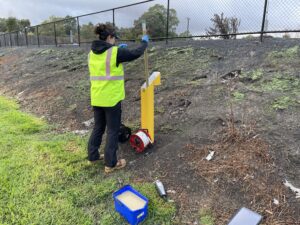
Using a monsoon
The monsoon pump is much more practical for purging larger bore volumes. This is because it is motorised and can purge up to 4 gallons per minute (depending on depth) from the bore, faster than the bailer discussed above.
The monsoon pump is avaliable in plastic and stainless steel and come in a range of sizes and lengths so they can be used in any bore.
Procedure
-
Calculating bore volume
Using you dip tape, measure the standing water level of the bore followed by the total depth of the bore. With this information you can calculate the volume of the water in the bore casing is calculated using the following formulae:
V = π r² x L x 1000
- V – volume (in litres)
- r – radius of the casing in metres, that is, half the inner diameter
- L – length of the water column in metres (TD minus standing water level, or SWL, measured to the same datum)
- π – constant (3.14)
Therefore the steps to calculate the casing water volume are:
- Measure the inner diameter of the bore casing in metres and halve it to obtain the radius;
- Measure the total depth of the bore or obtain this from the relevant bore database or the bore owner;
- Measure water level – the depth to the water table or water level;
- Calculate the length of the water column (total depth – water level);
- Calculate the volume of water using the formula above;
- Multiply by three to calculate three casing volumes;
- Approximate values of common casing widths are shown in Table 4 of Groundwater Sampling and Analysis – A Field Guide 28 .
Here’s an example:
See example below where the water column (L) is 10 meters and the diameter in the casing is 50mm or radius (r) of 0.025m:
- V = π r2 x L x 1000
- V = 3.14 (0.025)2 x 10 x 1000
- V = 3.14 (0.000625) x 10 x 1000
- V = 19.625 L
In the example above it will be required to purge at least 20 L x 3 = 60L before sampling utilizing the three well volume method.
It is often useful to know the time it will take to purge the bore. This is obtained by dividing the water volume (in L) by the average pumping or flow rate achieved (in L/sec or L/min). The latter can be simply measured using a bucket and watch.
2. Purging the bore
Bailer:
- Attach bailer to tagline;
- Lower bailer into bore until it has filled with water;
- Pull bailer out of bore;
- Pour groundwater retrieved into a bucket with measurements;
- Continue to remove water from well, taking incremental recordings of the water quality parameters.
QUIZ: Now you try using this example:
Your water column (L) is 18m and the diameter in the casing is 50mm.
Q: How much water do you need to purge using the three-well volume method?
If you are averaging 2L/min flow rate
Q: How long will it take you to pure your bore?